Appendix K – Method & Sources
This appendix sets out how the research was conducted, including source selection, evidence handling, and methodological principles. It includes the use of press archives, yearbooks, and structured extraction approaches.
Its purpose is to provide transparency and credibility. It makes clear how conclusions were reached and allows others to understand, replicate, or extend the work; reinforcing the book’s role as both narrative and research archive.
METHODOLOGY
This project did not begin with a method. It began with a sense that something was missing.
In conversations, in clubs, and in the way the history of the game was described, there was a persistent gap between what women had clearly done – played, organised, and sustained – and how that contribution was recognised. As more material surfaced, it became clear that this was not a question of absence, but of visibility. Women had not been peripheral to the game. They had been present, active, and building from the beginning.
The challenge, therefore, was not simply to gather information, but to establish a way of seeing it clearly, consistently, and at scale.
Participation, Evidence, and Structure
This book has been developed through a research methodology designed to reflect the way women’s golf itself evolved: not from the top down, but from participation outward.
Traditional sports histories often begin with institutions, championships, and recognised figures. This project takes a different starting point. It begins with the simple but historically overlooked fact that women were already playing, organising, and sustaining golf long before formal structures claimed authority over the game.
The task, therefore, is not only to document events, but to reconstruct how systems of participation emerged, stabilised, and endured.
Starting Point: Participation as Evidence
The research begins with participation itself.
Rather than treating early activity as anecdotal or incidental, instances of play, club formation, competition, and social organisation are treated as primary evidence of system-building. This reframes the analytical lens:
- from isolated events to patterns of behaviour
- from individual achievement to collective organisation
- from institutional records to lived structures of the game
In doing so, women are positioned not as later entrants into golf, but as active participants in its formation and continuity.
Multi-Pass Source Analysis
Primary sources are analysed through a structured, multi-pass method designed to preserve depth while enabling interpretation.
Each source is examined in four stages:
Signal Identification
Initial reading focuses on identifying observable actions, behaviours, and references to participation.
Quote Extraction
Verbatim passages are captured and catalogued to retain the language, tone, and perspective of the period.
Pattern Recognition
Recurring themes and structural features – such as club organisation, competition formats, and social norms – are identified across sources.
Structured Conversion
These patterns are formalised into stable analytical units that can be applied consistently across the book.
This process ensures that interpretation remains grounded in evidence while enabling system-level insight.
Gold Statements: Building a Traceable Argument
At the core of the methodology is the development of “Gold Statements.”
Each Gold Statement represents a distilled insight into how women’s golf functioned as a participation system. These statements are:
- derived from multiple evidence points
- expressed as clear, transferable insights
- mapped across chapters, appendices, and supporting outputs
They form the structural spine of the book, allowing individual pieces of evidence to contribute to a coherent and cumulative argument.
Appendices as Evidence Infrastructure
The appendices are not supplementary material, but an integral part of the research design.
They provide a parallel structure in which detailed evidence – clubs, competitions, press coverage, and material culture – can be documented in full. This allows the main narrative to remain readable while maintaining depth, transparency, and traceability.
Each appendix functions as:
- a repository of structured evidence
- a reference point for claims made in the narrative
- a mechanism for preserving material that would otherwise be lost through compression
This dual structure – narrative and appendix – ensures both accessibility and rigour.
Signal Detection and Historical Reframing
A key element of the methodology is the identification of early signals of system formation.
These include:
- informal competitions
- repeated patterns of play
- local organisational practices
- press references indicating continuity and scale
Such signals are often overlooked in traditional histories because they do not align with formal institutional milestones. However, when examined collectively, they reveal the presence of fully functioning participation systems.
Tracing these signals over time demonstrates that many later structures formalised – rather than originated – what women had already built.
Chapter Construction: Argument Through Structure
Chapters are constructed as layers of argument rather than linear timelines.
Each chapter is anchored by:
- a defined purpose
- a set of core themes
- mapped Gold Statements
- supporting quotes and evidence
- references to relevant appendices
This approach allows the narrative to move between example and system, showing not only what happened, but how and why it mattered.
Cross-Referencing and Traceability
A consistent cross-referencing system links:
- primary sources
- Gold Statements
- chapters
- appendices
This ensures that each claim can be traced back to its evidential basis. It also enables the material to be reused and extended across different formats, including digital publication.
Governance and System Integrity
To manage scale, complexity, and consistency, the research is supported by a defined governance structure.
This includes:
- controlled naming conventions and source registers
- versioned frameworks for chapters, appendices, and evidence
- structured mapping between sources, insights, and outputs
- explicit rules to prevent drift, duplication, and loss of traceability
This governance layer ensures that the methodology remains stable over time, allowing large volumes of material to be integrated without compromising clarity or control.
Integrating Past and Present
The methodology also incorporates contemporary observations as “signals” that reflect ongoing dynamics within the game.
These are used to highlight:
- continuity in participation structures
- recurring tensions between access and organisation
- the persistence of underlying system patterns
This integration reinforces the central argument: that participation-based structures are not historical artefacts, but active and continuing systems.
A Participation-Led History
Taken together, this methodology enables a different kind of historical account.
It does not seek to replace existing histories, but to reframe them by placing participation at the centre. In doing so, it shows that many of the structures associated with modern golf – clubs, competitions, pathways, and communities – were not imposed from above, but built from within.
This is not simply a story about women entering the game. It is a history of how women sustained it.
Methodology Framework
The methodology described above is summarised visually in Figures K1 and K2.
Figure K1 – Methodology Schematic: Participation → Evidence → Structure → Output
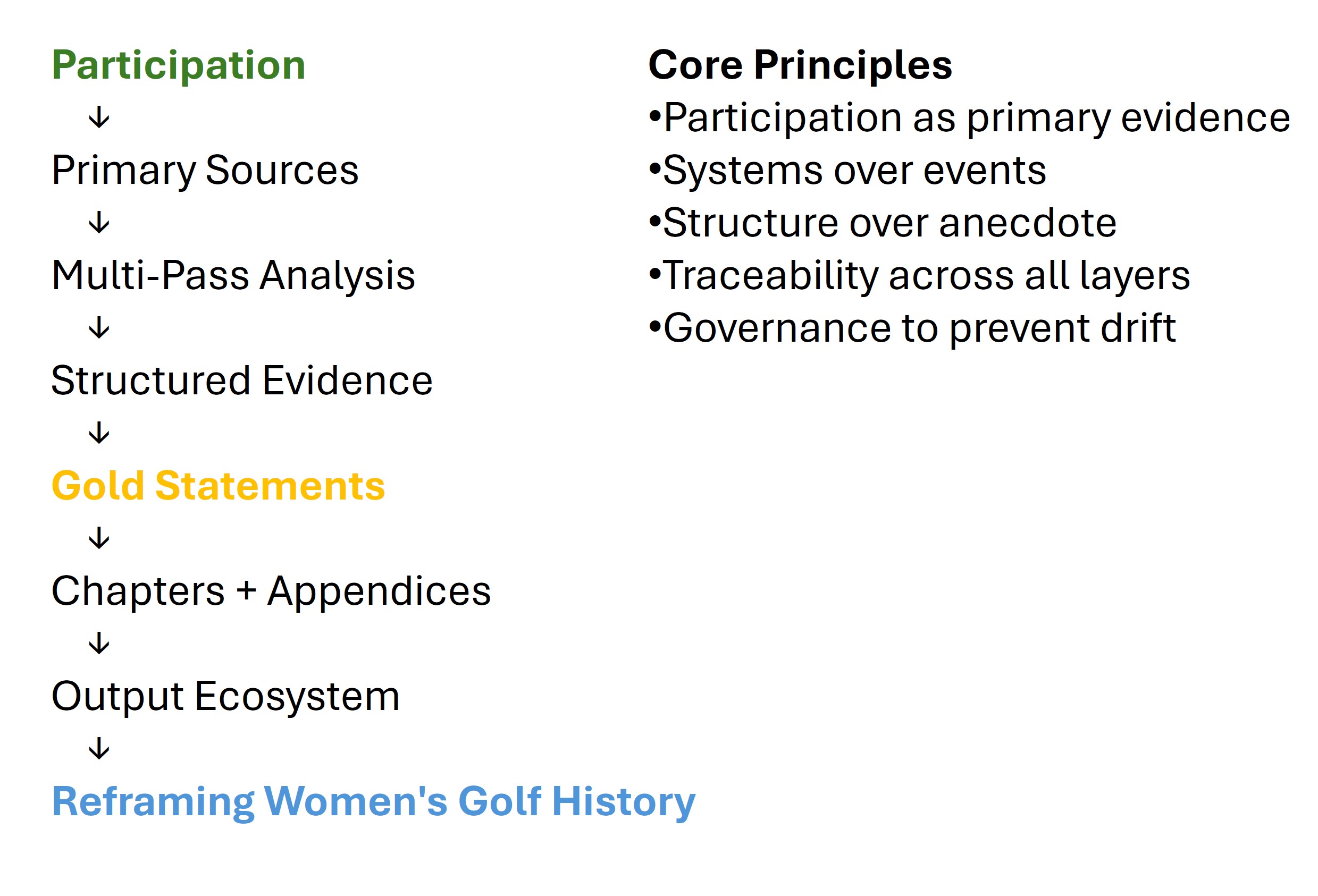
Figure K2 – Gold Statement Loop: Evidence → Insight → Structure → Validation
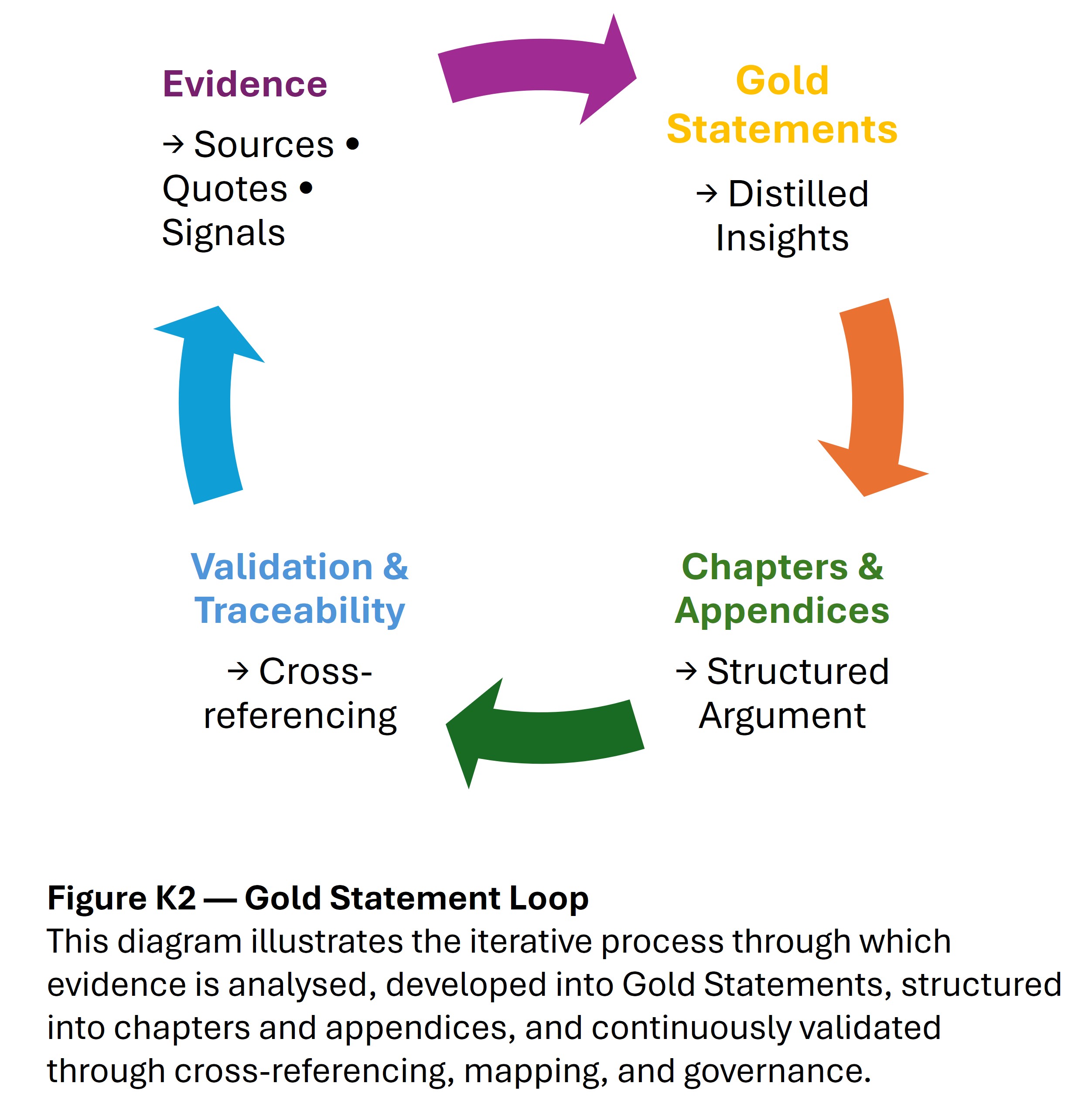
These figures illustrate the structured methodology and iterative analytical process used to develop the research and narrative of this book,
Women’s Golf history is shaped not by permission, but by participation and belonging.
← Previous: Appendix J – Participation & Social Context
Next: Archives and Collections→